TL;DR
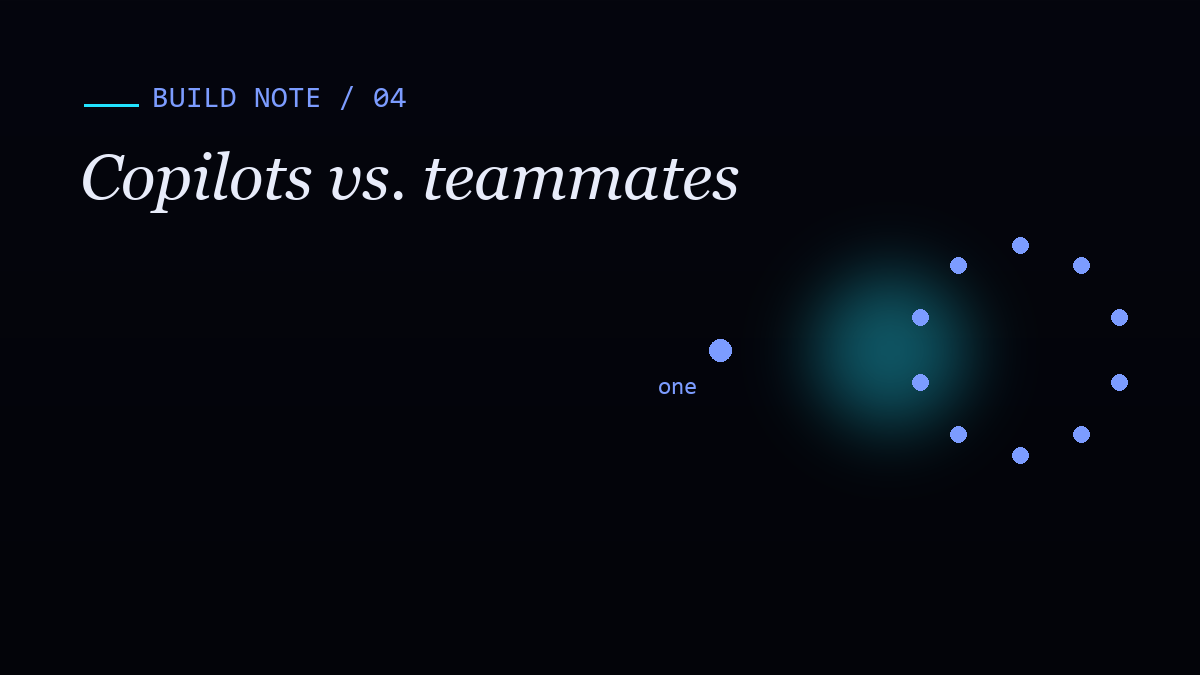
A copilot is a tool you operate — it suggests, you apply. A teammate is an agent you delegate to — it produces finished work you review. Copilots make you faster at what you were already doing; teammates change who does the doing. Hybrid V10’s position is both at once: agents as the team, copilots as the instruments the human seat uses to run it.
The industry markets two shapes of AI help, and the difference between them is not horsepower — it is who holds the pen. A copilot hands you suggestions all day. A teammate takes the assignment and hands you back a finished thing. Confusing the two is why so much AI tooling disappoints: you bought delegation and received autocomplete.
The copilot, fairly described
A copilot lives inside a tool you already use — the editor, the inbox, the spreadsheet. It drafts the sentence, completes the cell, suggests the reply. It is genuinely useful, and for the person who enjoys the work, it is the right shape: you stay the operator, the machine removes friction. The ceiling is also clear: at the end of the day, you were still the one working.
The teammate, fairly described
A teammate-style agent receives outcomes, not keystrokes. “Keep the newsletter shipping” is a copilot prompt only if you then assemble every issue yourself; it is a teammate assignment if a seat owns it end to end and hands you the finished issue to approve. The work moves from assisted doing to delegated producing — which is also why teammates demand governance that copilots never needed. You can approve or reject an autocomplete in real time; a queue of finished work needs the loop.
Side by side
- You operate a copilot; you brief a teammate. The interaction cost is a prompt stream versus a weekly direction.
- Copilots assist inside one tool; teammates work across the business. A copilot cannot chase an invoice and update the sheet; a seat can.
- Copilot failure is a bad suggestion you ignore. Teammate failure is a wrong finished product — which is why only teammates need an approval gate.
- Copilots amplify whoever is driving. Teammates add capacity where there is no driver at all.
When each is right
If the work is occasional, creative, and you-centered — the once-a-week task you actually enjoy — a copilot fits. If the work is recurring, standardizable, and drowning you — the weekly grind nobody wants — a teammate fits. Most businesses need both, and the mistake is buying only the first and wondering why the calendar never cleared.
Where Hybrid V10 lands
Ten teammate seats that own the recurring functions, a chief of staff seat that routes the work, and a human seat running the queue with copilot-grade instruments for the parts you keep. The model is not anti-tool — tools are what the seats are made of. The design claim is about the arrangement: delegation with a signature beats assisted overload.
Questions people ask
Is a copilot the same as an AI agent?
No. A copilot assists the person operating the tool; an agent takes delegated assignments and delivers finished work. The copilot’s unit of help is a suggestion; the agent’s is a completed task.
Which should a small business adopt first?
Copilots for the work you keep; agents for the recurring work you want gone. Starting with agents where the pain is recurring is what actually clears a calendar.
Does Hybrid V10 use copilots?
Yes — inside the seats and in the human’s review instruments. The design argument is about the outer shape: a team of producers with a human approver, not one person with ten autocomplete panes.
The ten teammates are documented in full. See the roster, or the loop they run. Join the interest list to follow the build.
The ten seats